how to come up with a business idea: 6 tactics, from your card statement to the next exponential
“we already know what people want because they're paying people to do it.”
the short version
paste any long episode into Podex and get the tactics, each with one concrete step, in a few minutes. that is how this list was built.
the six tactics
list the problems you hit every day: Pieter Levels on the Lex Fridman Podcast
6 tactics in ~224 minutes (13414s). 2.6M views on YouTube, per the Podex page. Levels has built more than 40 products alone. this play is tactic 05, Spot Problems By Moving Through The World Differently.
Lex asks the obvious question: how do you find a good idea? Levels, on the transcript: "I think you need to be able to spot problems." start with a normal morning: "What is stuff that I'm really annoyed with that's like in my daily life that doesn't function well?" then the method: "make a list of all these problems you have, and an idea to solve it, and see which one is viable." he says travel helps because "travel is uncomfortable" and you see apps abroad that "You can go back to your country" and build. "There's a lot of problems you start seeing, just getting out of your house."
the tactic: collect annoyances before you collect ideas. the problem list comes first. the idea is just the second column.
try this week: keep a note open for five days. every time something in your day does not work, write it down with one line on how you would fix it. on day five, circle the one you could ship a first version of yourself.
Pieter Levels, Lex Fridman
Charge Before You Build The Real Thing
Launch a payment link page before building anything, then handle orders manually until forced to automate.
Pieter Levels says
Before building a real product, I made an HTML page with a domain name, no backend code, just a Stripe payment link. People would get a link to a Typeform or an email to upload their photos after checkout. The first few hundred orders I handled completely manually, training models and generating the photos myself. Because the manual work became too much, I was forced to code something up to automate it.
Try this
Put up a landing page with a Stripe payment link and a form for delivery before writing backend code.

read your own credit card statement: Alex Hormozi with Jack Neel
12 tactics in ~98 minutes (5864s). 180K views on YouTube, per the Podex page. Hormozi co-founded Acquisition.com. this play is tactic 06, Use Your Credit Card Statement To Find Business Ideas. the episode has swearing; we only quote clean lines.
Hormozi remembers a college class where almost every business plan was an invention. his point, on the captions: "the vast majority of businesses are not inventions." think lawn care, laundry, car sales, insurance. so where do you look? "look at your credit card statement. Look at everything you spend money on. You are the customer." for each line he asks: "are any of these things are things that I'm interested in or things that I could do?" and he kills the pressure to pick perfectly: "your first business is not your last business. It is your first stepping stone."
the tactic: start from what you already buy. you know the customer, the price and the bad parts, because you are the customer.
try this week: export the last three months of your card statement. highlight every service you pay a person or a small business for. next to each, write one thing you would do better. keep the three you could start with little money.
Alex Hormozi, Jack Neel
Run The Affiliate Arbitrage Play
Negotiate a cut from a local business and run the sales process yourself.
Alex Hormozi says
Hormozi went to a local business and negotiated the cheapest price they would deliver their packages for. He had ads he recorded with his phone, posted them, and pushed them to a landing page. He called the leads on the Google Sheet to make sure they got scheduled. He let the business handle the delivery of the services and kept the cash. The fastest way to get to $100,000 is not the fastest way to get to a million or 10 million.
Try this
Pick one local business, negotiate a cut of sales you bring in, run a phone ad to a landing page, and call every lead the same day.

look at what people pay other people to do: Jake Heller at Y Combinator
8 tactics in ~39 minutes (2365s). 262K views on YouTube, per the Podex page. Heller co-founded Casetext, sold to Thomson Reuters for $650M. this play is tactic 02, Look At What People Pay Other People To Do.
Heller starts with the old YC line, make something people want, and says it just got easier. on the captions: "what do people want? For example, things they're paying for right now." his examples are customer support, insurance adjusters, paralegals, personal trainers and executive assistants. "we already know what people want because they're paying people to do it." so the search is simple: "now you just have to look what are people paying other people to do." then he sorts each job into a category, which is the free tactic below.
the tactic: start from paid work, not from a gadget. a job someone already pays for is demand you do not have to prove.
try this week: write 20 jobs people pay others to do, at work and at home. for each, mark assist, replace or unthinkable (the free tactic below). pick one and ask two people who pay for it what they hate about it.
Jake Heller, Y Combinator
Pick from the three categories: assist, replace, or unthinkable
Label your idea as assist, replace, or unthinkable before building anything.
Jake Heller says
There are categories to pick from when choosing an AI startup idea: assistance, where a professional needs help accomplishing a task, replacing the job entirely, and doing something previously unthinkable because it was too costly for humans to do before AI. Lawyers need a lot of help reading documents, doing research, reviewing contracts, marking them up, and making red lines, which is why CoCounsel helps lawyers, and some tasks like reviewing every document used to cost millions of dollars but now thousands of instances of Gemini 2.0 Flash can do it. Almost nobody picks ideas the way he recommends, by deliberately choosing one of these job categories first.
Try this
Write down your startup idea and force yourself to label it assist, replace, or unthinkable before doing anything else today.

hunt dead markets with proven money: Mark Pincus on My First Million
12 tactics in ~85 minutes (5114s). 43K views on YouTube, per the Podex page. Pincus founded Zynga. this play is tactic 02, Hunt Dead Markets With Proven Money. his proven-better-new test is already in our starting-a-business post. the episode has some swearing; we only quote clean lines.
Pincus calls this the play he would encourage anyone to consider. on the captions: "Find a mature market that's over, that's done, that's dead, that's been played out." his examples are online dating, eBay-style listings and unglamorous analog businesses. "They're almost not investable. Like VCs won't like them." the filter: "Find a market like that, but has a lot of money in it and has a proven behavior in it." for him that was video gaming in 2007, which he says was barely growing and not fundable, and he started Zynga there.
the tactic: go where the money is old and the attention is gone. a boring market already proved people pay. you only need a new angle on it.
try this week: list five markets people call dead or boring, where you know people still spend. for each, write the habit that never went away. pick one and write one new angle in a sentence.

run the 20-trend whiteboard: Kevin Ryan on The Tim Ferriss Show
12 tactics in ~76 minutes (4558s). 42K views on YouTube, per the Podex page. Ryan co-founded DoubleClick, Gilt, Business Insider and MongoDB. this play is tactic 05, Run The 20 Trend Whiteboard Exercise. the episode has a bleeped swear word.
Tim reads Ryan's own description of the exercise, on the captions: "list 20 ideas on the board of trends that I believe are going to exist for 10 years and then what are the implications that come out of that." Tim admits he skips the second step: "what will exist that doesn't exist today." Ryan explains the horizon: "to build an important company, unfortunately, you can't do it in two or three years. It does take 10 years." and the warning: "if it's something that is hypy today and is going to be done in 2 years or started 5 years ago, you're too late." he is honest about the hit rate: "I've gotten it wrong many times, but sometimes you get it right."
the tactic: list long trends, then their consequences. the business sits in the second column, not the first.
try this week: take a whiteboard or a page. write 20 trends you would bet hold for 10 years. next to each, write one thing it makes possible that does not exist today. cross out anything that is hype this year.

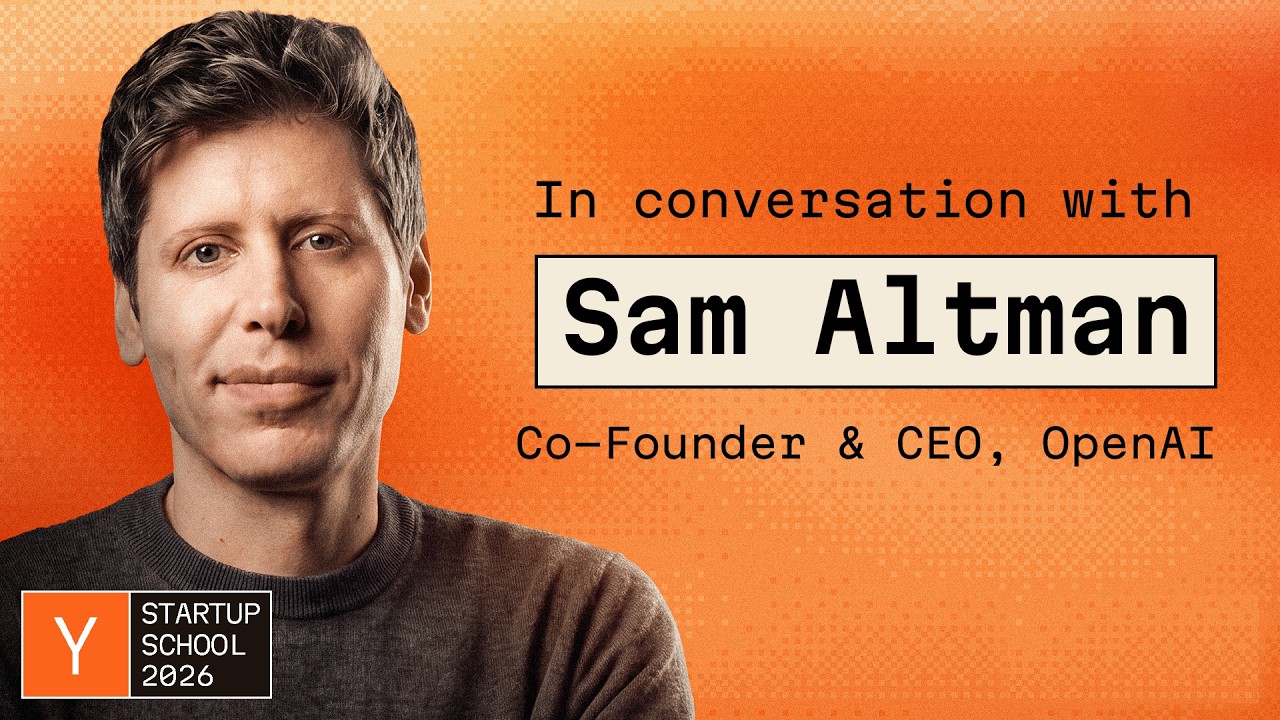
bet on the exponential the world has not priced in: Sam Altman at Y Combinator
8 tactics in ~39 minutes (2340s). 125K views on YouTube, per the Podex page. Altman is the CEO of OpenAI, speaking at YC's Startup School. this play is tactic 01, Find The Exponential The World Has Not Priced In.
Altman's advice to the room, on the captions: "figure out what the really big brand new thing is that is possible now that wasn't possible a few years ago." he borrows a Paul Graham line: "The world does not understand how to intuit exponentials." OpenAI's bet looked wrong to experts, and that kept rivals away. copying the hot startup has a cost: "you get a lot of hype and you can raise a lot of money," but he says those are less often the big outcomes. if your data keeps backing you, "be grateful that the world doesn't understand." and "you don't need a ton of people" to agree.
the tactic: hold a belief most experts call wrong, and keep testing it. if more data keeps backing you, the doubt is your head start.
try this week: write one thing that is possible now and was not three years ago in your field. list your evidence, and what would prove you wrong. look for the proof each week.
Sam Altman, Y Combinator
Find The Exponential The World Has Not Priced In
Find a belief others call wrong and gather evidence that it is actually right.
Sam Altman says
Find the things that you can develop reasonable conviction in that people decide the conventional wisdom is they're just wrong. At OpenAI, increasing data points convinced them they weren't delusional. Being dismissed meant they didn't have massive competitors and had time to do their research and build their company. Starting the same startup as everybody else gets a lot of hype and money, but those are much less frequently the big outcomes. There have got to be new exponentials forming right now, I don't know what they are.
Try this
Write down the one belief about your space that most experts would currently call wrong, and list your actual evidence for it.
a one-week plan to come up with a business idea
pick by problem
you have no ideas at all: Pieter Levels.
the play: keep a five-day note of every problem in your day, then pick one you can ship.
every idea you have is an invention: Alex Hormozi.
the play: read your card statement; you are already the customer of a dozen simple businesses.
you want an AI idea that is not a toy: Jake Heller.
the play: list what people pay other people to do, then mark assist, replace or unthinkable.
every market you like is crowded: Mark Pincus.
the play: hunt a dead market with a lot of money and a proven behavior still in it.
you chase whatever is hot this month: Kevin Ryan.
the play: write 20 trends that hold for 10 years, then what each one makes possible.
you keep copying the startup everyone copies: Sam Altman.
the play: find the new thing possible now that most experts still call wrong.
what this is not
every page above has more plays behind the free one: Pincus's Book of Life, Ryan's start impossibly narrow, Levels's payment button test, Heller's price against salaries. tactics, not takeaways.
one summary, every tuesday.
the tactics that matter, each with a step to run. unsubscribe anytime.
FAQ
How do I come up with a business idea with no experience?
Start with what you already know as a customer. Alex Hormozi says to read your own credit card statement, since you already pay those businesses, and Pieter Levels says to list the problems that annoy you in a normal day. Both lists need no experience, only attention.
Where do good business ideas come from?
In these six episodes, from four places: your own daily problems (Pieter Levels), your own spending (Alex Hormozi), work people already pay others to do (Jake Heller), and long trends or new technology most people have not caught up with (Kevin Ryan, Sam Altman). Mark Pincus adds old, unloved markets that still hold a lot of money.
Does a business idea need to be original?
No. Hormozi points out that most businesses are not inventions: lawn care, laundry, car sales, insurance. Mark Pincus goes further and says to look for markets everyone calls dead, as long as people still spend money and the behavior is proven.
How do I know if my business idea is good?
Test it before you build it. Our best podcasts for starting a business post covers two tests: Kevin Ryan's two-week business crush and Mark Pincus's proven-better-new check, done by hand. Pieter Levels also puts up a page with a payment link before writing real code, to see if anyone pays.
How do I come up with a startup idea in AI?
Jake Heller says to look at what people pay other people to do, then sort each job into assist, replace, or something that was unthinkable before because it cost too much. Sam Altman says to look for what is possible now that was not a few years ago, and to be glad if experts still think it is wrong.
How many business ideas should I write down?
Enough to choose from. Kevin Ryan's exercise starts with 20 trends on a whiteboard, and Levels says he once kept a long list because he expected only some to work. Write a long list this week, then keep three to test.
What are the best podcast episodes for business ideas?
Pieter Levels on the Lex Fridman Podcast, Alex Hormozi with Jack Neel, Jake Heller and Sam Altman at Y Combinator, Mark Pincus on My First Million, and Kevin Ryan on The Tim Ferriss Show. For what comes after the idea, see our best podcasts for starting a business post.