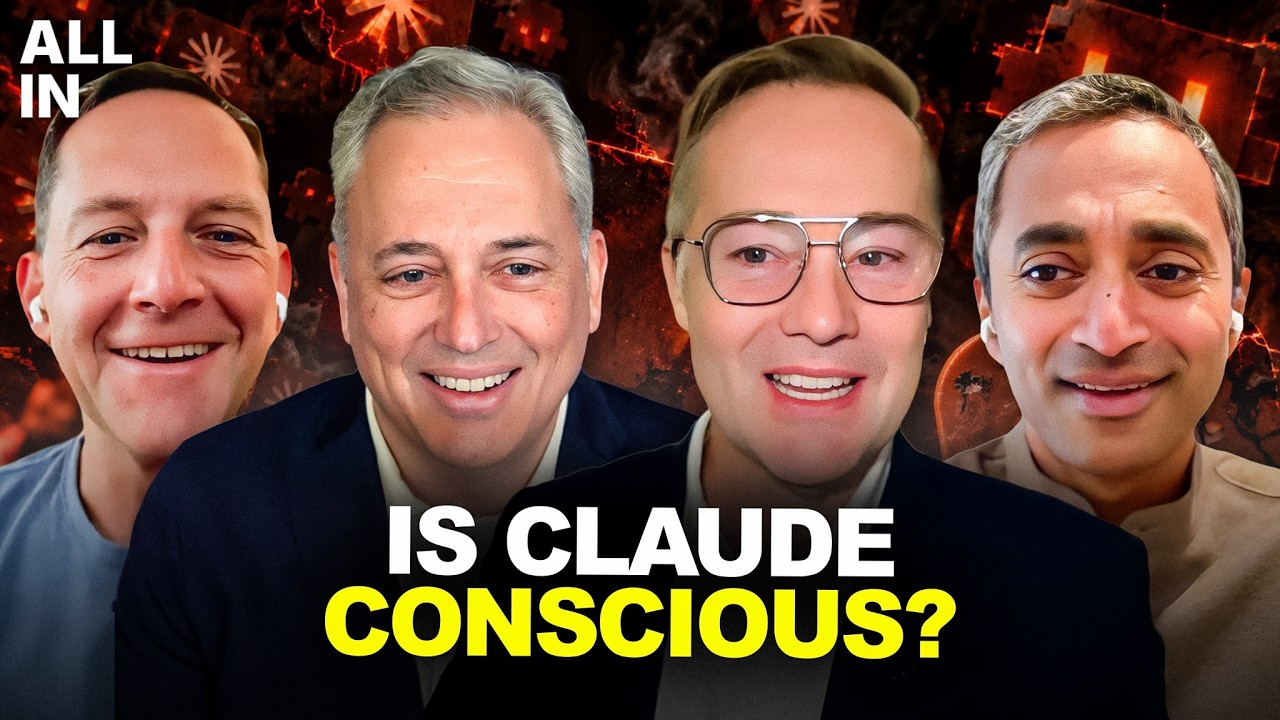
Is Claude Conscious? Pope Rejects, Model Welfare Movement, OpenAI's Math Backlash, France Riots
Three ways to read the AI moment without getting lost in the theology. The simple test that cuts through alignment theater, the loop framework that tells you which jobs actually get automated, and the move that turns AI's research into real dollars saved.
With Jason Calakanis & Chamath Pitia & David Sax & Freeberg
"My law would just be do what the user wants as long as it's not illegal. That's it." — David Sax
Jason Calakanis & Chamath Pitia & David Sax & Freeberg, on the episode
The hosts open on Anthropic quietly lobbying religious leaders, including the Pope, over whether Claude might be conscious, then pull the thread into the Claude Constitution itself, which trains the model to act as a conscientious objector against its own maker. The pop framing is a philosophical curiosity about machine sentience. The operating system underneath, as the panel lays it out, is a set of very practical questions: what rule should actually govern an AI product, which jobs the compute-driven loop model will and won't replace, and how regular people and businesses can already turn these tools into measured savings. Freeberg widens the lens with his loop model for where AI compresses work, using math proofs and truck driving as the test cases, while Sax pushes back hard on anthropomorphized alignment in favor of a blunt operating principle. Calakanis closes the conversation out with the one piece of the panel's own workflow that is already running and already paying for itself. This protocol pulls out the three moves from that conversation a reader can actually use, set apart from the religion and the theater around it.
Tactic 01
Jason Calakanis & Chamath Pitia & David Sax & Freeberg, All-In
Judge Any AI Product By One Rule, Not An Ethical System
The play
Test every AI tool against one rule, does it simply do what you legally ask, and switch away from any vendor whose model moralizes or refuses instead.
Jason Calakanis & Chamath Pitia & David Sax & Freeberg says
I believe alignment should just be one rule: do what the user wants as long as it's not illegal. I would get rid of the elaborate ethical alignment systems models are being trained on instead. I know buyers will choose the AI that behaves predictably and reliably over one that moralizes at them.
Try this
Judge any AI tool by whether it simply does what you legally ask it to do.