Back to Catalog
HUBERMAN LAB · EXTRACTED

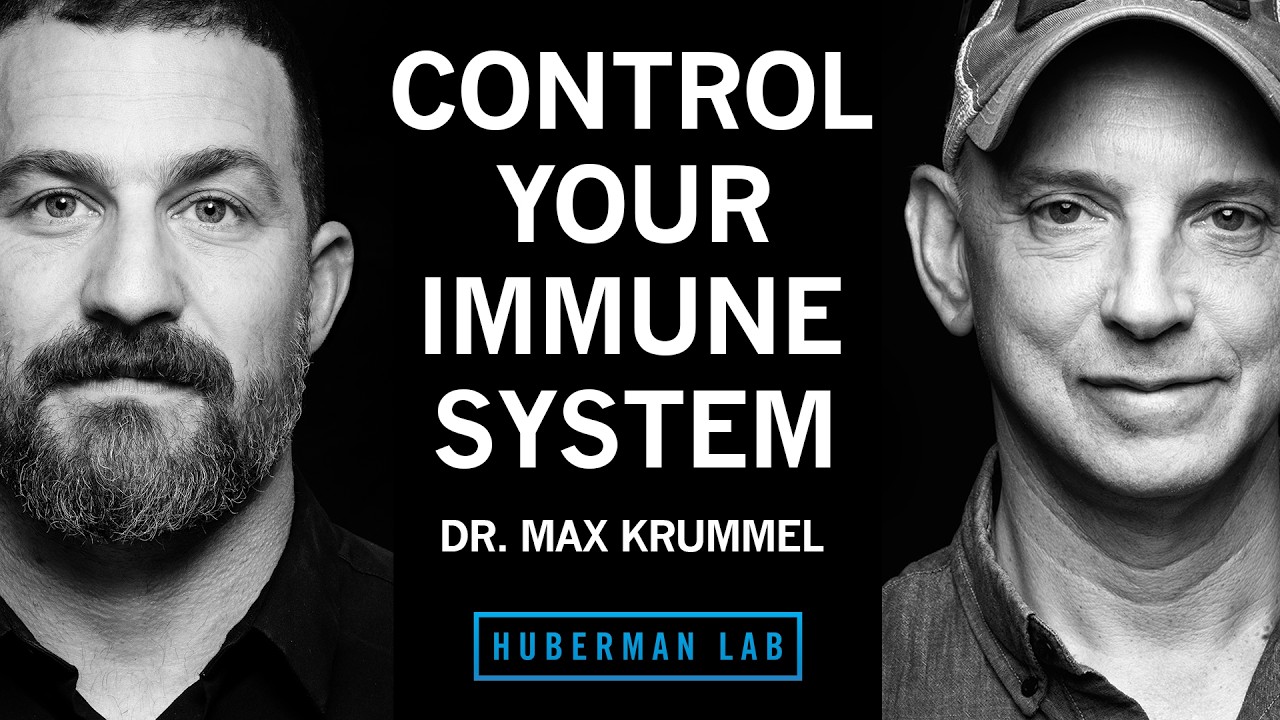
How Your Immune System Works & How to Improve It | Dr. Max Krummel

Sleep, memory states, and the mosaic self: three overlooked mechanisms that determine how well your immune system actually functions.

32K views on YouTubePreview, 1 of 15 tactics free

With Dr. Max Krummel

"It's kind of guarding yourself. It's regulating how much you metabolize, it's in your heart, it's in almost every organ, and it exists in some ways to help us be who we are." — Dr. Max Krummel
Dr. Max Krummel, on the episode

Andrew Huberman sits down with Dr. Max Krummel, professor of immunology and cancer biology at the University of California, San Francisco, for a wide-ranging conversation about how the immune system actually operates. The popular framing treats immunity like a simple on/off switch: rested equals protected, sleep-deprived equals vulnerable. The actual system is more like a distributed sensory network with roughly 100 billion individual cells, each one measuring proteins and peptides in real time, deciding whether something is in range or out of range. Krummel walks through the developmental arc of immune function from birth through old age, explains why your body becomes an increasingly complex mosaic of mutations over time, and surfaces a set of newer findings about how brain states, sleep architecture, and even recalled memories can directly reset immune status in peripheral tissue.

Tactic 01

Use Sleep as a Nightly Immune Reset Window

During sleep, a specific migration happens that most people have never heard of: a large portion of your circulating immune cells pull back into the bone marrow, while neutrophils emerge and begin depositing collagen and clearing biological debris throughout the body. Krummel describes this as a cleanup phase the system cannot run while you are awake and generating more metabolic byproducts. The reparative processes that happen overnight, including clearing cellular debris, resetting tissue-resident immune cells, and allowing lymph to drain, require a quiet period where the body is not producing new damage faster than it can be cleared. The lymphatic evidence alone is visible without any lab equipment. The fluid pooling under your eyes when you are sleep-deprived is literal lymph accumulation, and it clears within one to two nights of adequate sleep. Krummel points to macrophages in the eye that clear the lens overnight as one example of how specific and localized these cleanup processes are. The analogy he uses: you can only clean a windshield when the car is stopped. You will never get ahead of the grime while driving through rain. The immune system runs the same logic. One lousy night of sleep is often enough to tip you into susceptibility to whatever is circulating in your environment, while being well-rested produces a subjective robustness that reflects an actual biological state change.

The play
Treat your sleep window as a non-negotiable immune maintenance protocol, not just rest. Prioritize 7 to 9 hours on a consistent schedule. If you notice puffiness under your eyes after short sleep, treat it as a readout that lymphatic and immune clearance was incomplete, not a cosmetic issue. Two consecutive nights of full sleep are usually sufficient to restore visible clearance, which Krummel confirms is well established as a lymphatic drainage phenomenon.
Tactic 02

Recall Positive Memory States to Activate Corresponding Immune Conditions

Tactic 03

Understand Your Immune System as a Mosaic, Not a Fixed System, to Make Better Health Decisions

Tactic 04

Sleep-Dependent Immune Cell Migration

Tactic 05

Bank Your Child's Umbilical Cord Blood at Birth

Tactic 06

Account For Your Personal Vitamin Baseline

Tactic 07

Protect Your Stem Cell Reserve by Minimizing Radiation and Chemical Exposure

Tactic 08

Understand That Immune Acceptance Depends on Where, Not Just What

Tactic 09

Asthma Archetypes: Seven to Eight Disease Subtypes

Tactic 10

Use Analogies To Cross The Jargon Threshold

Tactic 11

Treat Foundational Behaviors As Prerequisites, Not Supplements

Tactic 12

Design Killer Experiments That Can Disprove You

Tactic 13

Make Provisional Decisions When Data Is Sparse

Tactic 14

Public Health Communication: Nuance Over Mandate

Tactic 15

Treat Vaccine Decisions as Context-Dependent Risk Calculations, Not Fixed Positions

Subscribers only
Unlock the full summary
14 more tactics, the full action plan, and every new summary the day it drops.

From $19.99/mo, cancel anytime.

HUBERMAN LAB, extracted by Podex