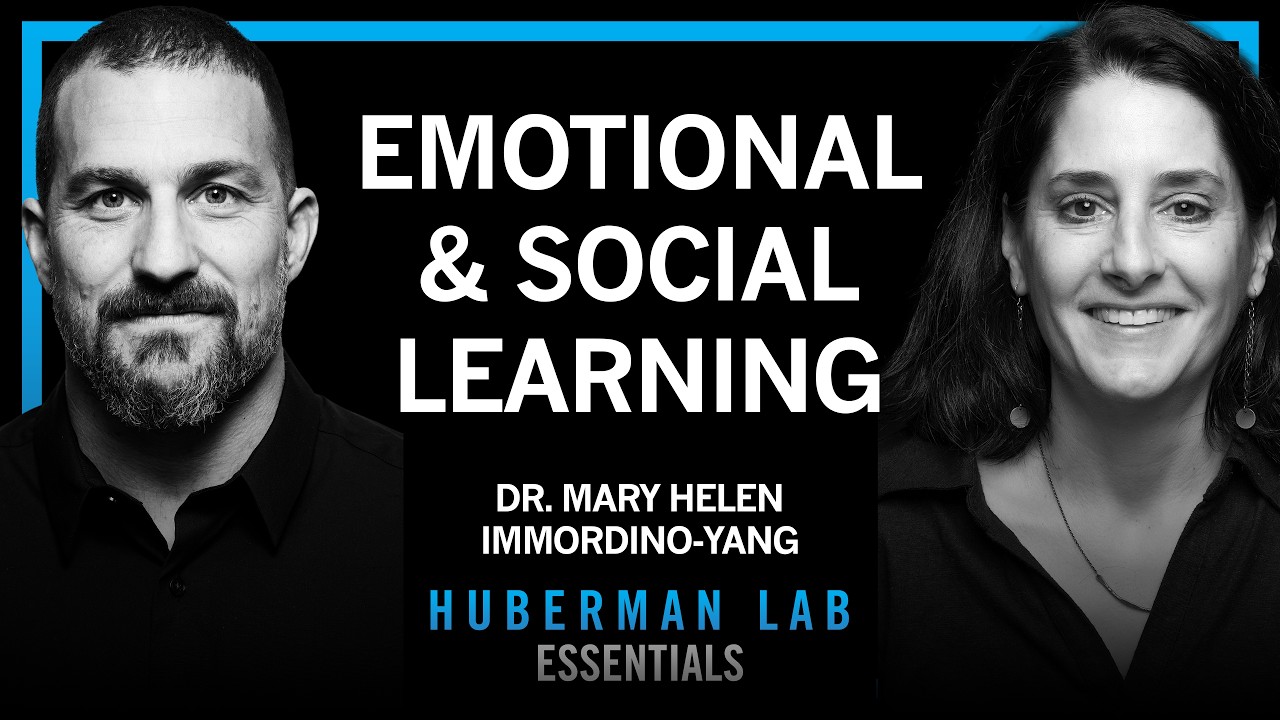
Essentials: How Emotions & Social Factors Impact Learning | Dr. Mary Helen Immordino-Yang
Why emotion decides what actually gets learned, and the real reason curiosity dies by adolescence. The fix isn't a new curriculum, it's rewiring what a learner's feelings are allowed to be about.
"So whatever you're having emotion about is what you're thinking about, right? And whatever you're thinking about, you could hope to learn about." — Dr. Mary Helen Immordino-Yang
Dr. Mary Helen Immordino-Yang, on the episode
Andrew Huberman sits down with Dr. Mary Helen Immordino-Yang, a professor of education and psychology at USC and director of the USC Center for Affective Neuroscience, Development, Learning and Education. The pop framing of learning treats it as an information-transfer problem: give a student facts, test whether they stuck. Immordino-Yang's actual model is that emotion is the substrate underneath cognition, not a distraction from it, and that what a learner feels about during a task is literally what gets encoded as learning. That reframes grades, curiosity, and even dehumanization as downstream effects of which stories and which emotional targets a person's mind has been trained to orient around. This pulls the operational pieces out of that conversation: how to interrogate your own narratives before acting on them, how to redirect a learner's emotional stake from outcome to idea, and how to use a person's actual interests as the entry point into hard academic skill.
Before acting on a strong emotional read of a situation, name the assumption underneath it and systematically seek out the other person's version before deciding.
Dr. Mary Helen Immordino-Yang says
I build a deliberate proclivity to question my own motives and deconstruct my own assumptions before acting on them. I engage with other people's perspectives systematically rather than assuming I already understand the situation. I treat this practice as a veto system that checks my own motivations against other people's actual experience of them.
Try this
Question your own motives and deconstruct your assumptions before acting, then check them against someone else's perspective.