ACQUIRED · EXTRACTED

Vanguard: The communist capitalist who saved investors a trillion dollars (Audio)

The cost matters hypothesis, mutual ownership, and how one disagreeable idealist transferred a trillion dollars from Wall Street to ordinary investors.

Preview · 3 of 5 tactics

"I realized that a mutual company would never provide me with the personal fortune that so many denizens of Wall Street would earn, but it offered, I believe, my last best chance to resume my career." — Jack Bogle

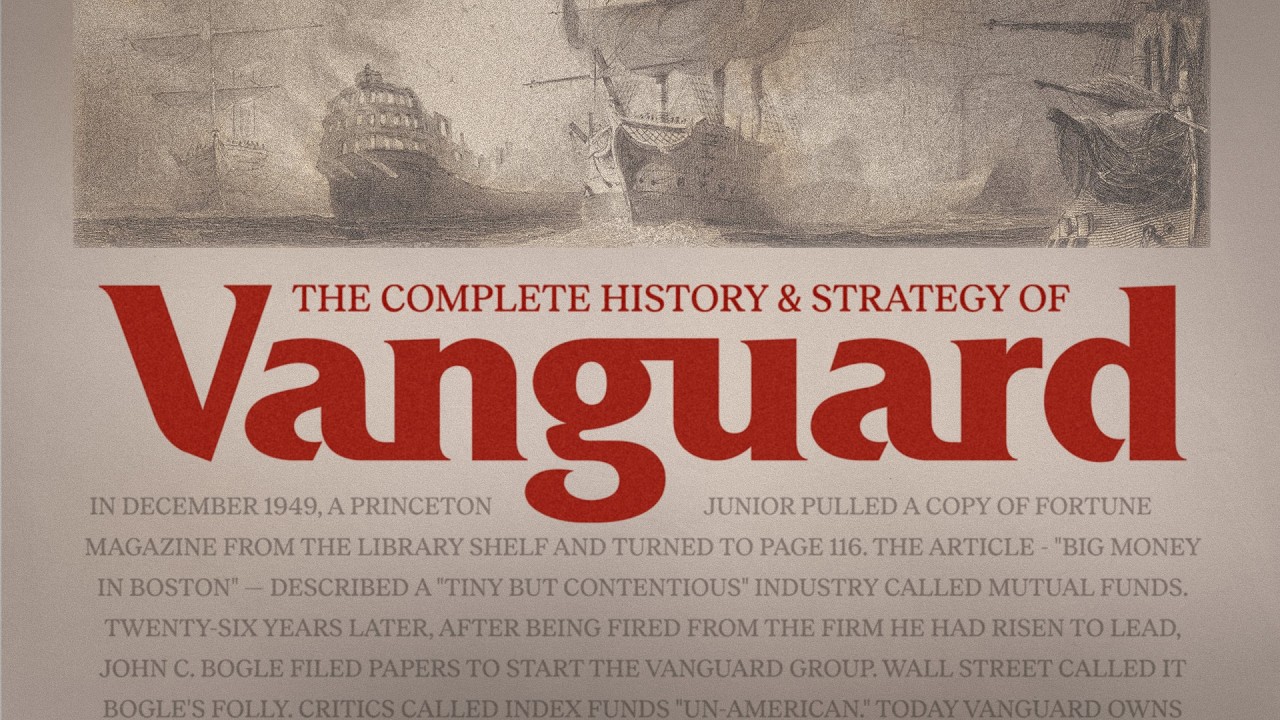
Ben Gilbert and David Rosenthal spend this episode of Acquired tracing the full arc of Vanguard and its founder Jack Bogle, from Depression-era poverty through a boardroom firing that accidentally birthed the modern index fund. The pop framing of Vanguard is that it is a scrappy low-fee alternative to Wall Street. The actual operating system is stranger and more radical: a company that is legally incapable of generating profits for shareholders because the shareholders are the customers. Bogle did not build this out of pure idealism. He built it because he had been fired and needed a vehicle to continue his career, and the mutual structure was the only move left. What he set in motion, deliberately or not, has transferred an estimated one trillion dollars in fees out of the finance industry and into the pockets of ordinary investors since 1975.

TACTIC 01

Strategy Follows Structure

Bogle's most quoted line on Vanguard is not about index funds or fees. It is about governance. 'Strategy follows structure,' he would say. By designing Vanguard so that the fund holders were also the owners, he made low fees the only rational outcome. The board of directors elected by investors would always vote to lower fees when they could, because doing so was in their own financial interest. There was no separate class of shareholders to disappoint. This is the thing most people miss about why Vanguard's fees are low. It is not discipline or virtue or competitive pressure, though all three play a role. It is structural inevitability. Every time Vanguard lowers its expense ratio, it is the functional equivalent of a normal company reporting higher earnings. The surplus gets returned to customers, just without the taxable dividend event. At 0.07 percent average expense ratio today, compared to an industry average of 44 basis points, the structure is still doing exactly what Bogle designed it to do fifty years ago.

THE PLAY

Before you design any incentive, pricing, or governance structure for your organization, write down who benefits when costs go down. If the answer is not your customer, redesign until it is. The structure determines the strategy. Get the structure wrong and no amount of stated mission will hold.

TACTIC 02

The Cost Matters Hypothesis

Bogle ran the numbers in the mid-1970s and found that the S&P 500 index, with no active management, beat roughly half of active fund managers after fees over a given year. Over a full decade, it beat 78 percent of them. The reason is not that active managers are incompetent. It is that fees compound against you the same way returns compound for you. Here is the arithmetic Gilbert lays out in the episode. You invest 100,000 dollars at age 25. The market returns 7 percent annually for 40 years. With no fees, you end up with 1.5 million dollars. With a 1 percent annual management fee, your effective return drops to 6 percent and you end up with 1 million dollars. That 1 percent fee costs you 500,000 dollars, which is 33 percent of your final balance. The fee sounds small. Its compounded drag is enormous. Bogle called this the cost matters hypothesis, and it was the thing he was actually obsessed with, not indexing as a religious cause but fees as a mathematical enemy of long-term returns. Bogle also understood the aggregate math. All active investors together are the market. Every winner on a trade has a loser on the other side. In aggregate, before fees, active managers return exactly the market. After fees, the median active manager underperforms by precisely the amount of their fees, every year, automatically. You cannot identify the winners in advance with enough reliability to justify that structural disadvantage over decades.

THE PLAY

Pull the expense ratio on every fund you currently hold. Multiply the fee percentage by 7 to get a rough estimate of what percentage of a typical year's market gains you are surrendering before you even start. If any fund charges more than 20 basis points and is not demonstrably uncorrelated with the market, compare its 10-year net-of-fees return against the Vanguard 500 or Total Market fund. Let the numbers make the decision.

Newsletter

Get each new playbook the day it drops

One email per drop. No spam. Unsubscribe anytime.

TACTIC 03

The Loophole Is the Product

When the Vanguard fund board gave Bogle permission to operate in 1974, they gave him the narrowest possible mandate: run the back office. No investment advisory. No marketing. No distribution. The fun stuff stayed with Wellington Management Company. What Bogle was handed was the accounting, the tax filings, the fund holder register, the correspondence with newspapers about daily prices. Bogle's response was to read the restriction literally and find the gap in it. If he was prohibited from offering investment advisory services, then a fund that required no investment advisory services was within his mandate. An index fund, by definition, does not require anyone to decide what to buy. It simply owns whatever is in the index. He took this argument to the fund board, they agreed, and the first retail index fund was born from a legal technicality, not a strategic plan. The same logic applied to distribution. When Bogle finally won the right to handle distribution in 1981, he did it by arguing he was not taking over distribution, he was eliminating it. No more sales loads paid to brokers. No more 8.5 percent off the top. He was simply making the fund available directly, which was, in his framing, the absence of distribution rather than the presence of it. The constraint shaped the product. The restriction created the innovation.

THE PLAY

Find the one thing your organization has been told it cannot do in a given domain. Write down the literal definition of the prohibition. Then ask whether there is a version of the product or service that falls outside that definition by design, not by exception. The constraint you are working around may be pointing directly at the better product.

Subscribers Only

Unlock the Full Playbook

2 more tactics + Action Plan

  1. TACTIC 04

    Scale Economies Shared

  2. TACTIC 05

    Don't Just Do Something, Stand There

Subscribe for $19.99/mo

Already subscribed? Log in

ACQUIRED · EXTRACTED BY PODEX