HUBERMAN LAB · EXTRACTED
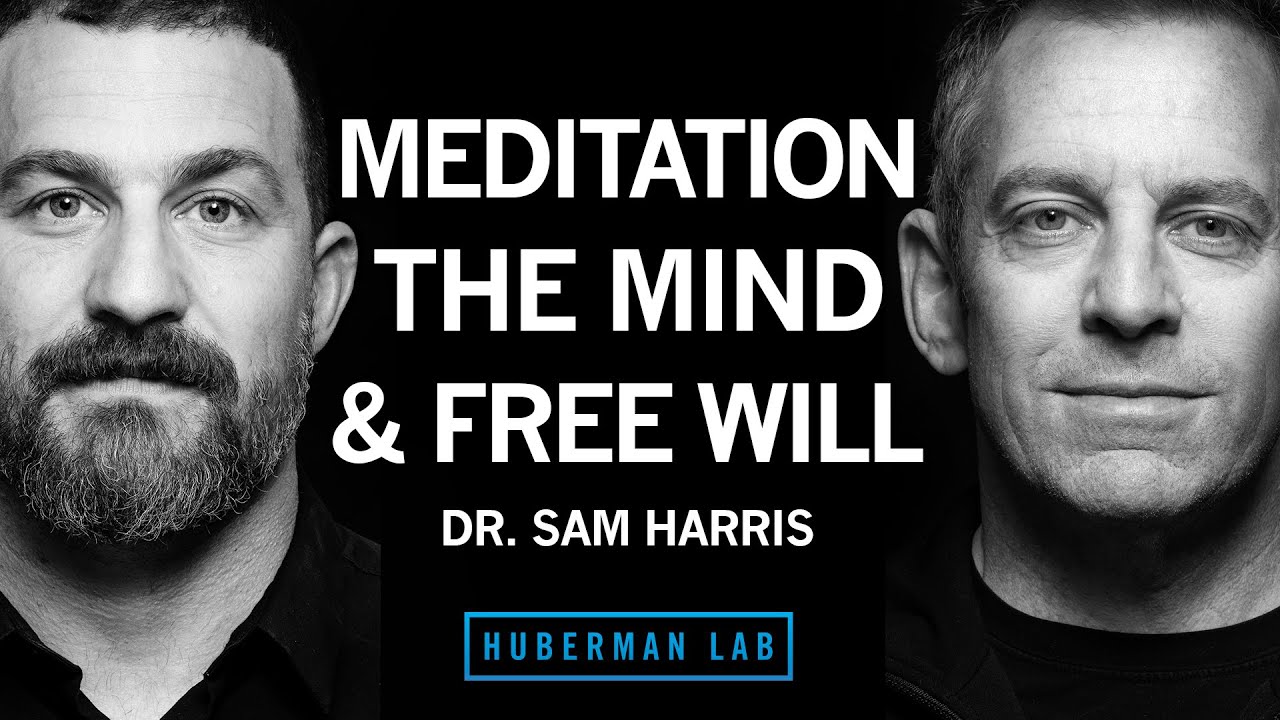
Using Meditation to Focus, View Consciousness & Expand Your Mind | Dr. Sam Harris
The self you've been trying to improve may not exist the way you think it does. Three practices for seeing through the central illusion and what opens up on the other side.
Preview · 3 of 15 tactics
"The self is what it feels like to be thinking without knowing that you're thinking." — Sam Harris
Andrew Huberman sits down with neuroscientist and philosopher Dr. Sam Harris to go well past the standard meditation pitch of stress relief and better focus. The pop framing of meditation is that you practice it to change how you feel. Harris argues the real target is something most practitioners never touch: the sense that there is a subject separate from experience, a locus of attention distinct from the things being attended to. That felt separation, he says, is not a feature of consciousness. It is an illusion produced by thought going uninspected. This protocol pulls three of the most operationally concrete moves Harris describes for dissolving that illusion and what the two-step function of practice actually looks like from the inside.
Look for the One Who Is Looking
Most meditation instruction sets up a subject-object structure before practice even begins. You sit down, close your eyes, and aim your attention at the breath. That framing quietly assumes there is a you doing the aiming, separate from whatever is being observed. Harris calls this dualistic practice, and while it produces real benefits, it reinforces the very illusion serious meditation is meant to dissolve. The alternative is to actually look for the one who is looking. Not as a thought experiment, but as a direct inspection. When you are paying attention to a sound, a breath, or a thought, locate the subject that is supposedly doing the attending. Harris says you will not find it. Not because you looked in the wrong place, but because there is no place to look. The sense of being a locus of attention, a passenger behind the face, turns out on inspection to be just another appearance in consciousness, not the thing holding the flashlight. Harris uses the analogy of a tourist who joins the search party that is looking for her. The search goes on for hours, helicopters are readied, and then she realizes she is the missing person. The problem does not get solved in the way the search implied it would. It simply evaporates. That is the structure of the meditative insight he is pointing at. You are not going to find a self and then dissolve it through sustained effort. You are going to look, fail to find one, and discover the looking itself was based on a false premise.
THE PLAY
Sit down and close your eyes. Choose any object of attention: the breath, ambient sound, a physical sensation. For two to three minutes, pay attention to it normally. Then shift the question. Instead of attending to the object, try to locate the subject. Where exactly is the one who is watching? Is there a center to experience, or just experience? Do not try to answer conceptually. Treat it as a perceptual search, the same way you would try to spot a specific object in a room. When the sense of a center dissolves even briefly, notice what remains. That noticing is the thing Harris says most people spend years of formal practice trying to reach.
Watch Anger Dissolve the Moment You Stop Thinking About It
Harris makes a concrete claim about negative emotional states that most people can test within a week of basic mindfulness practice. The physiology of anger, fear, or anxiety has its own half-life. Left alone, it degrades fast. The reason those states feel durable is not the physiology itself. It is the thinking about it that keeps the furnace running. When you are angry, you are almost always also thinking about why you are angry, rehearsing what you will say, cataloguing the evidence for your grievance, and imagining how the other person will respond. Each of those thoughts re-triggers the cortisol and the associated body state. The feeling and the narrative are a loop. Mindfulness breaks the loop not by suppressing the thought but by seeing it as a thought, a spontaneous object in consciousness rather than something identical to you. Harris draws a precise distinction here. Before you have this skill, you are the hostage of the state for however long you are going to be in it, with no lever to pull. After you have it, you can decide how long to stay angry based on whether anger is actually useful in the situation. That is not detachment or emotional numbness. It is having an exit available that was not there before. He frames this as the first major step function in a meditation practice, the moment when the difference between being lost in thought and not being lost in thought becomes experientially unmistakable.
THE PLAY
The next time a negative emotional state arises, do not try to reduce it or reframe it. Instead, stop actively thinking about the cause. Redirect attention to the raw physical sensation in the body: the tightness, heat, pressure, or whatever is actually there. Hold attention on the sensation without the narrative for 60 to 90 seconds. Notice whether the intensity changes. Harris says the physiology degrades quickly once the story stops being fed. Do this enough times that the loop between thought and body state becomes visible to you as a mechanism, not just a mood.
Newsletter
Get each new playbook the day it drops
One email per drop. No spam. Unsubscribe anytime.
The Two Step Functions of Practice
Harris rejects the idea that meditation is a linear accumulation of calm. He describes two discrete jumps, step functions, where the practice changes in kind rather than just degree. Most people spend their entire time in the first phase without knowing the second exists. The first step function is the clean recognition of the difference between being lost in thought and being genuinely aware of experience. Before this, you assume you are mostly present and occasionally distracted. After it, you discover the ratio is nearly inverted. Harris says if you sat right now and tried to pay attention to a single object for 30 seconds without being pulled into internal commentary, you almost certainly could not do it. And a meaningful fraction of people who try would think they succeeded when they did not, because the thought stream runs so quietly they mistake it for silence. The first step function is the moment that gap becomes unmistakable. The second step function is the non-dual shift Harris has been describing throughout the conversation. This is where the sense of being the one who is meditating, the subject aiming mindfulness at objects, itself dissolves. What replaces it is not blankness or absence. It is the recognition that consciousness was always already without a center, and there is nothing to find because nothing was ever missing. At this point the practice is no longer something you do for a portion of the day. It becomes, in Harris's framing, simply what is happening when you are not distracted. It is compatible with a conversation, a hike, a meal, anything.
THE PLAY
Use the 30-second test to locate yourself in the first phase honestly. Set a timer. Pick one object: your breath, a hand, or a sound. The single instruction is to keep attention on it without being pulled into internal dialogue for the full 30 seconds. Not suppressing thought, just noticing the moment attention leaves the object and returning immediately. If you lose the thread and do not notice for 10 or 15 seconds, that is data. Run this test daily for one week before each formal session. The gap between where you think your attention is and where it actually is will become visible, and that visibility is the beginning of the first step function.
Subscribers Only
Unlock the Full Playbook
12 more tactics + Action Plan
TACTIC 04
Rip The Band-Aid Off Social Media
TACTIC 05
Try the Waking Up App Free for 30 Days
TACTIC 06
The Blind Spot Is Right Here
TACTIC 07
Feel the Pain Fully and Watch It Come Apart
TACTIC 08
Take The 30-Second Attention Test
TACTIC 09
Recognize Your Context-Dependent Self-States
TACTIC 10
Reverse The Causality Of Happiness
TACTIC 11
When The Signal Is Clear Enough, Stop Deliberating
TACTIC 12
Use Fear As A Flag, Not A State
TACTIC 13
Post and Ghost
TACTIC 14
Feel the Emotion, Not the Story About It
TACTIC 15
Drop the Meditator
Already subscribed? Log in
HUBERMAN LAB · EXTRACTED BY PODEX