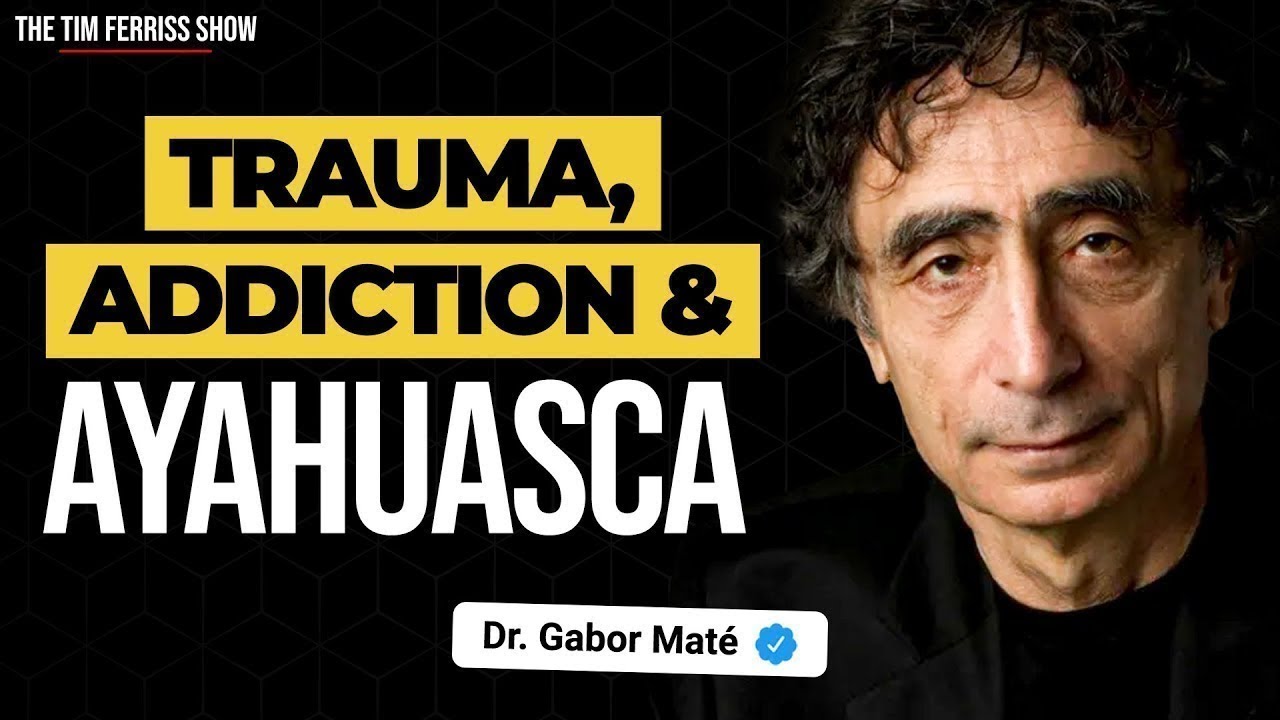
THE TIM FERRISS SHOW · EXTRACTED
8 tactics for understanding pain instead of fighting its symptoms. The core idea most people get backwards: the addiction, the rage, the numbing are not the problem, they are someone's attempt to solve one.
"Addiction is not the primary problem, it's an attempt to solve a problem." — Dr. Gabor Maté
Maté is a physician who spent twelve years working with addiction in Vancouver's Downtown Eastside, alongside decades in family medicine and palliative care. The pop framing of his work is "trauma talk." The actual operating system underneath is a clinical model: behaviors people hate in themselves, the addictions, the rage, the tuning out, all began as coping mechanisms that worked when the person was young and powerless, then got programmed in and kept running long after they stopped helping. This protocol pulls the specific reframes and practices he uses to move someone from self-condemnation to self-connection.
Maté's central move is to stop treating the behavior as the problem and start treating it as a signal. When he asks someone what their addiction does for you, the answers are always some version of relief: it numbs me, it soothes me, it makes me feel connected, it gives me a sense of control. Every one of those is a response to pain. So the useful question is never "why did I do this," which is a verdict disguised as a question, but "why the pain." That single shift moves the inquiry away from brain chemistry and willpower and toward the person's actual life and history, which is where anything fixable lives. This is why he argues conventional treatment keeps failing. It manages the effects, the behavior and its fallout, while ignoring the cause, the original distress the behavior was built to handle. You cannot resolve something by fighting the symptom that is trying to tell you it exists.
THE PLAY
The next time you catch yourself in a behavior you dislike, replace "why do I keep doing this" with "what does this do for me, and what is the pain underneath it." Write down the relief it provides: numbing, calm, control, connection, escape. That relief points at the real problem. You are not trying to fix the behavior in this step, you are trying to name what it has been protecting you from.
Maté calls his method compassionate inquiry, and the distinction he draws is between two nearly identical sentences. "Why did I do this" said one way is a self-condemnation. Said another way it is a genuine question. The difference is whether you bring curiosity or judgment. He points out that the dog whisperer gets results through calm and compassion, and that the moment a person feels attacked or shamed, they shut down and protect themselves, which ends any chance of insight. The reason this matters is mechanical, not sentimental. Shame triggers the same defensive shutdown that caused the problem in the first place. Curiosity does the opposite. It keeps the nervous system open enough to actually look at what happened.
THE PLAY
When something goes wrong and the self-attack starts, notice the tone of your own internal question. If it sounds like a prosecutor, you will learn nothing. Restate it as actual curiosity: "I wonder what made me react that way." Treat the answer as information about your history, not as evidence against your character. This is hard to do alone with deep material, which is why Maté is clear that most people need a skilled therapist for the heavier work.
Maté's name for a coping mechanism that outlived its usefulness is the stupid friend. It is a friend because it genuinely tried to help you, it numbed pain or got you through something. It is stupid because it never learned that the danger passed, so it keeps running the same move decades later, now causing harm instead of protecting you. The trap most people fall into is hating the behavior, which means hating a part of themselves, which only deepens the shutdown. The reframe Tim describes from his own recovery is to thank the behavior for the role it played, acknowledge the necessity it filled, and then release it because it is no longer needed. Maté endorses this directly. You are not at war with the coping mechanism. You are retiring it with respect.
THE PLAY
Pick one coping behavior you have been fighting and hating. Write down, specifically, how it once served you: what it got you through, what it protected, what it made survivable. Acknowledge that it did its job. Then state plainly that the situation it was built for is over and you are choosing to set it down. Maté and Tim both pair this with loving-kindness practice directed at the younger version of you who needed it.
Maté draws a sharp line that most people miss: trauma is not what happens to you, it is what happens inside you as a result. The divorce, the absent parent, the abuse, the loss, those are traumatic events. The trauma is the internal consequence: disconnection from your emotions, disconnection from your body, difficulty being in the present, a negative view of yourself, a defensive view of others. He notes you can also be wounded by good things that should have happened and did not, the attunement and acceptance a child needed but a stressed parent could not give. This distinction is what makes healing possible. If the trauma were the event, it would be fixed in the past and untouchable. Because the trauma is the living internal pattern, it shows up in the present, which means it can be worked with in the present.
THE PLAY
Separate the two columns for one painful chapter of your life. On one side, the events, what actually happened. On the other, the internal adaptations you still carry: the disconnection, the defenses, the beliefs about yourself. The work is not relitigating the events. It is noticing where those old adaptations are still firing in your present-day life, because that is the part you can actually change.
Maté frames a tragic conflict at the root of most disconnection. Children have two non-negotiable survival needs: attachment, the closeness that keeps them cared for, and authenticity, staying connected to their own feelings and gut sense. When being authentic threatens the attachment, when a parent cannot handle your anger or sadness and withdraws love in response, the child suppresses the authenticity every time. Attachment wins because attachment is survival. The cost is that you lose contact with yourself and later wonder whose life you are living. He uses an Elvis lyric, "anyway you want me, that's how I will be," to make the point. It is presented as a love song. It is actually a lack-of-love song, a person offering to erase themselves in exchange for acceptance.
THE PLAY
Look for the places you go quiet, agreeable, or self-erasing to keep a relationship smooth, especially where it costs you your real reaction. Ask which feelings you learned were unsafe to express, and with whom. You are not trying to blow up your relationships. You are noticing the specific trade you make between being yourself and being accepted, because seeing the trade is the first step to stopping it.
Maté walks Tim through a live exercise that exposes a universal pattern. You do not respond to what happens, you respond to your perception of what happens. When a contractor failed to do work he had promised, Tim's instant reaction was anger and the belief that the man did not respect or care about him. But there were a dozen other possible explanations, illness, an accident, a lost email, the man's own stress. Of all the readings available, Tim's brain jumped automatically to the worst one. And it was not a choice, it was a default. The reason that worst interpretation feels true is that it is old. It is being triggered from a much earlier time when you first felt uncared for. The payoff of seeing this is power. If your pain is caused by what the other person did, you are a victim of them. If you can see that you supplied the interpretation, you become the source, and the source can change things.
THE PLAY
Next time something upsets you, before reacting, force out three alternative explanations that have nothing to do with you being disrespected or unloved. Notice which interpretation your mind reached first and whether it was the harshest one. Then ask where you have felt exactly this before. The goal is not to excuse other people, it is to stop being run by an automatic story written when you were young.
Maté treats intention as the thing that determines whether an experience works, and Tim sharpens it into the rule that matters: an intention is not an expectation. Going into a hard or unusual experience with a fixed expectation you cannot release means spending the whole time resisting whatever actually happens because it does not match the script. A clear intention is a direction, not a demand. Maté applies this to everything from a single ceremony to a holiday with his wife, where, as a recovering workaholic, he had ruined past vacations until they started doing them with a stated intention and a plan for handling conflict. The deeper version is what Tim calls treating the obstacle as the work. The thing that hinders your task is your task. The annoyance, the person who will not stop talking, the reaction you did not want, that is the material, not an interruption to it.
THE PLAY
Before any significant experience, a difficult conversation, a retreat, even a vacation, write one specific intention: what you want to learn or how you want to show up. Then deliberately drop the expectation of a particular outcome. When something inconvenient comes up during it, treat that as the actual assignment rather than a problem to remove.
Maté is direct that recovery means reconnection, and that talk alone often cannot get there because trauma lives partly in the body, below the reach of the analytical mind. He lists the body-based modalities he respects, somatic experiencing, EMDR, tapping, intentional yoga, and explains that these reach the emotional brain faster than conscious conversation can. His own case is the concrete one. He spent years saying he was not a yoga person because his ADHD mind could not sit still, until at seventy-plus he started a 50-minute daily yoga practice, which he does every morning, and it made a measurable difference to his ability to stay present. He also describes the physical preparation his ayahuasca retreats require, no caffeine for a period, no red meat, reduced salt, no dairy, as a way of making the body more receptive. The point that generalizes is that the body is not a side channel to the mind. It is a primary route in.
THE PLAY
Add one body-based practice to your week and treat it as non-negotiable, not optional. It does not have to be exotic: a short daily breath or movement practice, or a structured modality like somatic work or EMDR with a trained practitioner if you are working through real trauma. Maté's own lever was a fixed time, every morning, same practice. Consistency at a set time beats intensity you do sporadically.
YOUR ACTION PLAN
All the plays, back to back. Use this as your checklist.
Ask Why The Pain, Not Why The Addiction
For any behavior you dislike, name the relief it gives you, then name the pain underneath it.
Run A Compassionate Inquiry Instead Of A Self-Verdict
Catch the prosecutor tone in your own questions and replace it with genuine curiosity.
Thank The Stupid Friend, Then Let It Go
Write how an old coping behavior once served you, acknowledge it, then deliberately retire it.
Separate The Trauma From The Thing That Happened
List the events on one side and the internal adaptations you still carry on the other, then track the adaptations in your present.
Find Where You Traded Authenticity For Attachment
Notice where you go self-erasing to keep a relationship smooth, and which feelings you learned were unsafe.
Catch The Worst Interpretation, Then Find Its Source
Before reacting, generate three alternative explanations and ask where you have felt this exact hurt before.
Set An Intention, Not An Expectation
Write one specific intention before any significant experience, drop the fixed outcome, and treat obstacles as the work.
Rebuild The Connection Through Your Body
Add one fixed, recurring body-based practice and protect the time, professional support for deeper trauma.
Ep. 002
8 tactics for building a meaningful life out of suffering, order, and chaos. The starting point is not grand. It is reading your own resentment and fixing what is directly under your control.
Read playbook →Newsletter
One email per drop. No spam. Unsubscribe anytime.
THE TIM FERRISS SHOW · EXTRACTED BY PODEX