MODERN WISDOM · EXTRACTED
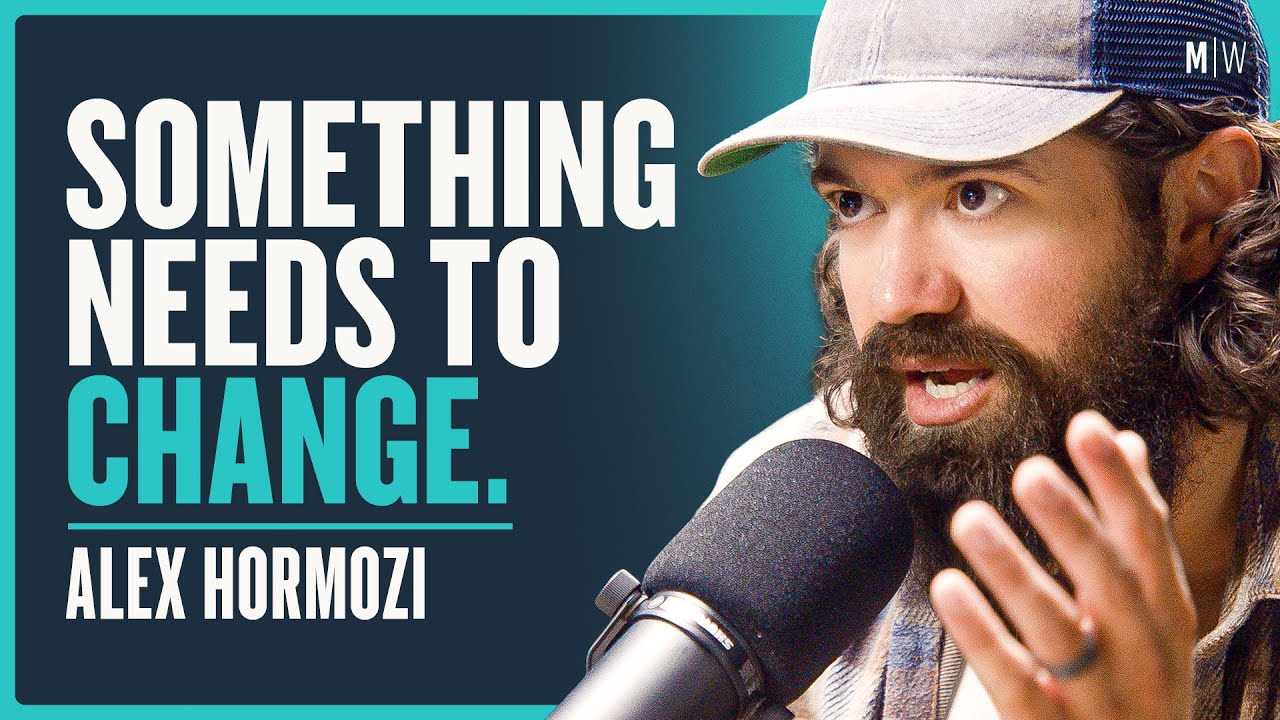
Modern Wisdom ft. Alex Hormozi
Compressing decisions, capping success, and why the work works on you more than you work on it.
"I'd rather be optimistic and wrong than pessimistic and right." Hormozi's version: "I'd rather have absolute power and have nothing to show for it than have all the things to show for it but know that I'm life's bitch." — Alex Hormozi
This is a three hour conversation between Chris Williamson and Alex Hormozi recorded around the launch of $100M Leads. The frame Williamson runs is going through Hormozi's tweets one by one and unpacking them. That format is deceptive. Hormozi's tweets are notes to self, which means each one is a compressed operating principle he uses on himself, not a piece of content. The conversation is mostly Hormozi explaining the mental machinery underneath each compressed line. This protocol pulls the most operationally useful pieces from that machinery.
Compress The Decision Cycle
Hormozi's most quantitative claim in the episode is about decision speed. The average operator takes about a week to make a meaningful decision, then their mind moves on to the next anxiety, then another week, then another, then another. Four decisions take a month. The high-output operator makes each decision in roughly a day. Four decisions take four days. Same quality of decision, same person, same brain, just a different policy on cycle time. "That's how you can go 30 times or 100 times faster than the quote average person." The mechanism underneath this is what Williamson calls anxiety cost. Every second you spend revisiting an unmade decision is a second you've paid for not making it. "The longer that you wait until you answer that email, the more times you will think the thought 'I need to answer that email.'" The thought itself is a tax. The decision being unmade is a tax. The only way to stop paying the tax is to make the decision and free the mental compute for the next one. Most people lose the bulk of their lives to a small backlog of unmade decisions they keep mentally re-opening.
THE PLAY
List the three unmade decisions currently sitting in your head. The conversation you keep rehearsing, the email you keep not sending, the hire or fire you keep modeling out. Set a 24-hour clock on each one. The decision doesn't need to be perfect. It needs to be made. The reclaimed mental bandwidth from closing those three loops is worth more than the marginal improvement you'd get from another week of deliberation.
Cap Success So It Doesn't Eat The Skill That Made It
Hormozi describes deliberately capping his own success. He turns down millions in speaking and corporate work, refuses most podcasts, and keeps going back to what he calls "the mental lab" — long stretches in quiet rooms doing the work that originally produced the success. The framing he uses: past wins are a resume, not a current capability. The skills that produced the wins decay if they aren't used. If you spend all your time enjoying the outputs, you stop generating the inputs. He extends the same logic to opportunity. "When you don't have anything to say no to, it's easy to focus on one thing. As success begins to get you more opportunities, your ability to say no becomes increasingly important." He uses Williamson's frame here — the woman in the red dress from The Matrix. Every new opportunity is a woman in the red dress, and the better you get the hotter she becomes. The cost of saying yes scales with how successful you are.
THE PLAY
Audit your last 90 days of calendar. Separate activities that produced past success from activities that are downstream of past success. If downstream activities have grown faster than upstream ones, cap them. Pick one prestigious yes and turn it into a no this quarter. Reinvest the hours back into the mental lab work that built the thing in the first place.
Define Commitment By Eliminated Alternatives
Hormozi's distinction between deciding and committing is one of the sharpest reframes in the episode. A decision is a thought. A commitment is the elimination of alternatives. "You're not committed until you remove the other options." People claim to have committed to leaving a job, ending a relationship, starting a business, but they leave the escape hatches open. The escape hatches are why nothing happens. His own story is the example. He didn't tell his father he was leaving home until he was five states away. Not because he was ready, because the only way he could make himself ready was to remove the option of being talked out of it. "I was so afraid of my father's disapproval that I didn't tell him until I physically left the state." Eliminating alternatives wasn't a sign of commitment, it was the mechanism of commitment.
THE PLAY
Identify a current commitment you've made on paper but not in practice. The diet, the side project, the boundary, the deadline. List the escape hatches that are still open. Then close one this week. Cancel the membership, tell the people, sign the lease, send the email. The commitment becomes real at the moment one of the alternatives stops existing.
The Region Beta Paradox: Make Things Worse To Make Them Better
This is Williamson's frame and Hormozi immediately runs with it. Imagine you walk a mile or less and drive anything farther. Paradoxically you reach a destination two miles away faster than one mile away, because the worse situation triggered a better response. The general principle: people only take action when discomfort crosses a threshold. Comfortable complacency, the just-okay job, the acceptable relationship, the mediocre apartment, is actually a worse trap than something acutely bad, because acutely bad triggers the activation energy that comfortable complacency suppresses. Hormozi: "If I look back on the instances that were the most painful in my life, every single one of them without fail has created a disproportionate gain." Quitting the job, the DUI that forced him to end multiple bad partnerships, losing all his money the first time which forced him into the licensing model. The bad situations were the only events that crossed the threshold required to take action he should have taken years earlier.
THE PLAY
Find the area of your life that is okay but not good. Not the area that's on fire, the area that's quietly stagnant. If you're waiting for it to get bad enough to act, you'll wait years. Manufacture the threshold instead. Tell the person, quit the thing, list the apartment, post the resignation. You will reach a better state faster by deliberately worsening the comfortable one than by waiting for the comfortable one to collapse on its own.
Become The Output Of The Work, Not The Outcome
The most freeing reframe in the conversation is Hormozi's response to the question of wasted work. He spent five years building a chain of gyms, finally hit a payday selling five of them, put the entire payday into a partnership where the partner stole the money and disappeared to Sweden. By every external metric the five years were wasted. In the twelve months after, he made more than he had in the previous five combined. His read in retrospect: "I am the output of the work, not the outcome." The five years built the skills, work capacity, sales ability, and operational instincts that the next twelve months ran on. The outcome of the five years was him. The outcomes that other people measure showed up later as a side effect. He extends this to the present: "The work works on you more than you work on it. If you want to be the best in the world at something, you do the work to become the best in the world, and the work works on you."
THE PLAY
For your current biggest effort, write down two outputs. First, the external outcome you're aiming at. Second, the version of you that will exist if you put in the work regardless of whether the outcome arrives. The second one is guaranteed to materialize. The first one isn't. Run the work for the guaranteed output. The unguaranteed one is more likely to show up as a byproduct of doing that than as a result of optimizing for it directly.
Operationalize Emotions Into Actions
Hormozi's most clinical move in the conversation is treating emotions as protocols rather than experiences. He defines each one by the action it requires. Sadness is a lack of perceived options, which is just ignorance, which means the action is to go learn. Anxiety is too many options and not enough priorities, which means the action is to list and rank. Impatience is the desire for an outcome that hasn't arrived, which becomes manageable the moment you redefine it as figuring out what to do in the meantime. "Patience is figuring out what to do in the meantime." The frame works because it strips emotions of their power to stall action. An emotion stops being something happening to you and becomes a signal pointing at a specific next move. "What used to take days of anxiety and feeling this frog in my throat was just 'oh I need to make a list of all the things that I'm looking at, which one's the most important, ignore the rest, and then I'm good.'" Days become minutes.
THE PLAY
Pick the emotion that costs you the most time this year. Define it operationally. What action does it actually indicate. Sadness points at learning. Anxiety points at prioritization. Anger points at an unmade decision or unheld boundary. Resentment points at a conversation you haven't had. Write the if-then. Next time the emotion shows up, run the action instead of sitting with the feeling.
Build A Stack Of Undeniable Proof
The Hormozi line Williamson keeps coming back to: "You don't gain confidence by shouting affirmations in the mirror but by giving yourself a stack of undeniable proof that you are who you say you are. Outwork your self-doubt." The mechanism matters more than the line. Confidence isn't generated by thoughts about yourself. It's generated by evidence about yourself. Affirmations try to shortcut the evidence step. The shortcut fails because the deep brain knows what you've actually done and what you haven't. His worked example is the presentation he was preparing for in the episode — a webinar to 500,000 registered people. He walked through his prep cycle: full draft in his head, full draft out loud, recorded, played back with slides, edits to every stumble or missing visual, repeat until "there's nothing else I can do to it." The point of the process isn't perfect output. The point is that when he walks on stage, he has a stack of undeniable proof that the work was done. The audience never sees that stack. He sees it. That's enough.
THE PLAY
Pick the next high-stakes thing you'll do. Define what "nothing left to do" looks like before you start. Not the outcome, the input. Then do that work whether or not anyone will know. When the moment arrives, the confidence isn't something you need to manufacture in the room. It's already there because the evidence is already there. The standard you're aiming at is: when you walk off stage, you can look in the mirror and say good work, and mean it.
YOUR ACTION PLAN
All the plays, back to back. Use this as your checklist.
- 01
Compress The Decision Cycle
Pick three unmade decisions. 24-hour clock on each. Reclaim the bandwidth.
- 02
Cap Success So It Doesn't Eat The Skill That Made It
Turn one prestigious yes into a no this quarter. Reinvest the hours into the lab work.
- 03
Define Commitment By Eliminated Alternatives
Pick a commitment that's on paper but not real. Close one escape hatch this week.
- 04
The Region Beta Paradox: Make Things Worse To Make Them Better
Find the okay-but-not-good zone. Manufacture the threshold for action instead of waiting for collapse.
- 05
Become The Output Of The Work, Not The Outcome
Define the version of you that the work will produce regardless of result. Run for that output.
- 06
Operationalize Emotions Into Actions
Define your most expensive emotion as a protocol. Write the if-then. Run the action next time.
- 07
Build A Stack Of Undeniable Proof
Define "nothing left to do" before the next high-stakes thing. Do that work. The confidence shows up automatically.
Newsletter
Get each new protocol the day it drops
One email per drop. No spam. Unsubscribe anytime.
MODERN WISDOM · EXTRACTED BY PODEX