LEX FRIDMAN · EXTRACTED

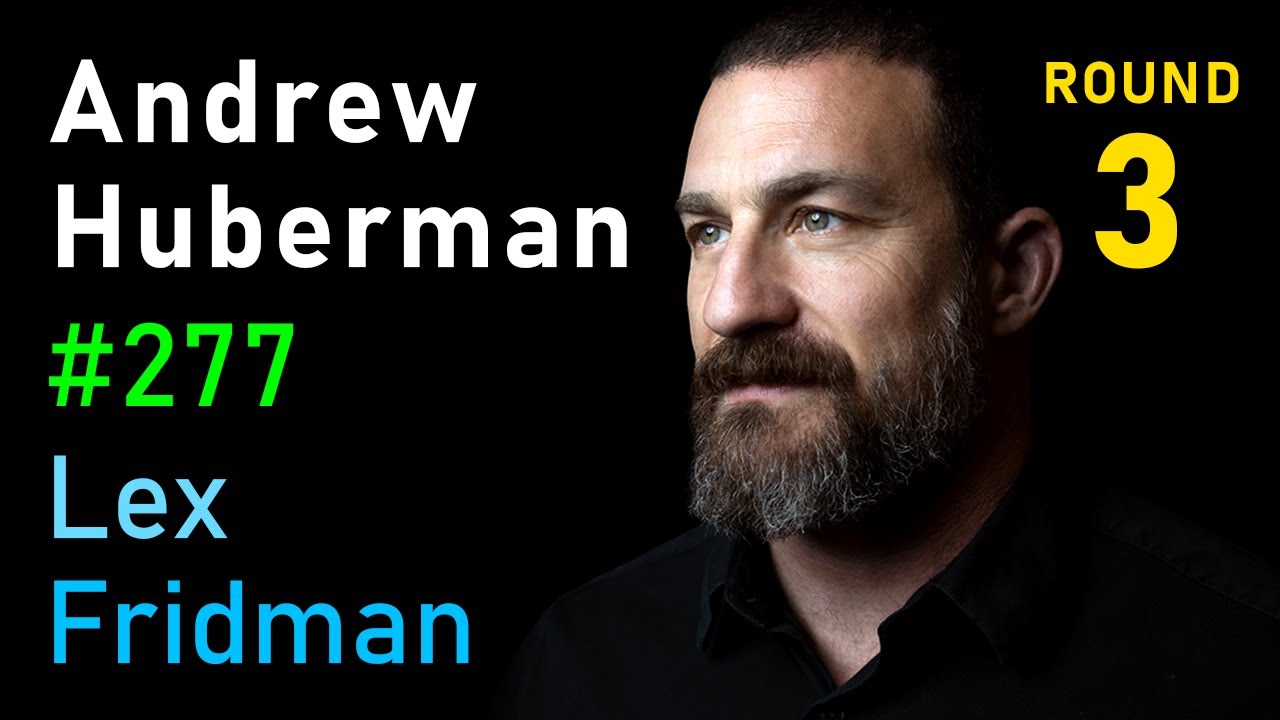
Andrew Huberman: Focus, Stress, Relationships, and Friendship | Lex Fridman Podcast #277

Getting into state, sauna protocols, training science, and the neuroscience underneath the things that actually matter in life.

Preview · 3 of 6 tactics

"The cure for boredom is curiosity. There is no cure for curiosity." — Andrew Huberman

This is Andrew Huberman's third appearance on Lex Fridman's podcast, recorded in Austin. The pop version of Huberman is the guy with the morning sunlight routine and the supplement stack. The actual operating system underneath is more interesting: a scientist who has spent serious time reverse-engineering his own mental states, borrowing from Rick Rubin, Carl Deisseroth, and Olympic-level athletes to build protocols that work. The conversation ranges from pre-podcast rituals to sauna frequency to training science to the neuroscience of romantic attachment, and what holds it together is Huberman's consistent move of translating a mechanism into something you can do this week.

TACTIC 01

Calibrate Your State Before You Do The Work

Before recording his solo podcast episodes, Huberman does not sit down and start. He walks his neighborhood alone, no phone, singing song lyrics out loud for roughly ten minutes. The point is not warm-up for its own sake. It is diagnostic. He is listening to whether his words are coming out faster than he can articulate them, or slower than his thoughts are moving. "There are days when I have so much energy that I'm trying to speak faster than I should in order to articulate properly. There are other days when I'm tired and I can't sort of keep up with my thoughts." The walk also pulls his vision into what he calls panoramic mode, a deliberately wide visual field that activates calming circuits in the brain stem. He uses it to downshift before the session demands precision. The whole sequence, lyrics, open vision, checking his internal RPM, is his version of what Rick Rubin taught him: you have to do the work to do the work. You cannot flip a switch into a focused creative state. You have to ratchet through the steps that get you there. This is not a productivity hack. It is an acknowledgment that your brain does not shift states instantly, that the transition itself requires deliberate engineering. Huberman applies the same logic to the state he wants for recording that athletes apply to the state they want for competition. Tiger Woods was taught self-hypnosis young. Huberman sings Joe Strummer lyrics on a residential street in front of his neighbors.

THE PLAY

Before your next high-stakes work session, take a ten-minute walk without your phone. Spend the walk reciting or singing lyrics from a song you know cold, and use that as a readout: if the words are tumbling out faster than you can land them, you are over-aroused and need to slow down; if you are dragging, you need to find something that raises the energy before you sit down. Do not open your laptop until you have completed the diagnostic.

TACTIC 02

Use Sauna Frequency To Cut Cardiovascular Risk In Half

Huberman cites Finnish sauna research that tracked all-cause mortality and cardiovascular death across different sauna frequencies, holding other variables like smoking and relationship status constant. The numbers are specific enough to act on. If you get into a sauna at 80 to 100 degrees Centigrade (176 to 212 degrees Fahrenheit) for 30 minutes two to three times per week, you reduce the likelihood of dying from a cardiovascular event by 27 percent. Four or more sessions per week brings that reduction to 50 percent. For a completely different goal, specifically a large growth hormone release for recovery and fat metabolism, the protocol looks different. You need to get into the sauna for 30 minutes, exit for 5 to 10 minutes with no cold exposure, re-enter for another 30 minutes, and repeat that cycle up to two hours total. The catch is frequency: to get that hormonal spike, you do not do this more than once a week. More frequent exposure blunts the response. The two goals, longevity and growth hormone, require opposite approaches to frequency. Huberman is direct about infrared saunas: they top out around 160 to 170 degrees Fahrenheit, which is not hot enough to trigger the acute physiological responses he is describing. If you want the heat shock proteins, the growth hormone release, or the cardiovascular mortality data to apply to you, you need the uncomfortable heat, the kind where you want to get out but choose to stay.

THE PLAY

For cardiovascular benefit, get into a traditional sauna at the highest temperature you can safely tolerate (targeting the 176 to 212 degree Fahrenheit range) for 30 minutes, four or more times per week. If your goal is a growth hormone spike instead, limit sauna to once per week but extend the session to two hours total using a 30-minutes-in, 5-minutes-out rotation. Do not combine the two goals in the same week.

Newsletter

Get each new playbook the day it drops

One email per drop. No spam. Unsubscribe anytime.

TACTIC 03

Time Your Cold Exposure Around Training

Huberman says this was a surprising correction to a belief he already held going into his conversation with Andy Galpin. He assumed that ice baths after training reduced hypertrophy somewhat but not enough to matter much. Galpin's answer was that it is a big deal, enough to meaningfully short-circuit your progress. Cold water immersion within the four hours after a strength, hypertrophy, or endurance session reduces the inflammation that serves as the actual signal for adaptation. You are washing out the stimulus before your body can respond to it. The exception is athletes in season who are not primarily trying to grow or get stronger, people doing skill development or recovering between competitions where the goal is simply to perform again tomorrow. For them, cold immersion after training makes sense. For everyone else trying to build something, the rule is to push cold immersion to a different time of day entirely, or to do it before training rather than after. Heat after training is different. Huberman says sauna immediately post-session is likely beneficial because it dilates blood vessels and delivers more nutrients to muscles and connective tissue. Cold showers are also a partial exception: they do not appear to blunt the training adaptation the way full immersion does, because they do not produce the same degree of metabolic disruption. The key distinction is whole-body immersion versus surface exposure.

THE PLAY

Do not get into an ice bath or cold water immersion in the four hours after a training session aimed at building strength, muscle, or endurance. If you want cold exposure on a training day, do it before the session or move it to a non-training day. Sauna immediately post-training is fine and may help with recovery. Cold showers are also fine and will not blunt your gains the way a cold plunge will.

Subscribers Only

Unlock the Full Playbook

3 more tactics + Action Plan

  1. TACTIC 04

    Train The 3x5 Way For Strength

  2. TACTIC 05

    Add One All-Out Sprint Per Week To Build Endurance

  3. TACTIC 06

    Use The Soberg Principle To Maximize Cold Exposure Benefits

Subscribe for $19.99/mo

Already subscribed? Log in

LEX FRIDMAN · EXTRACTED BY PODEX