LEX FRIDMAN · EXTRACTED
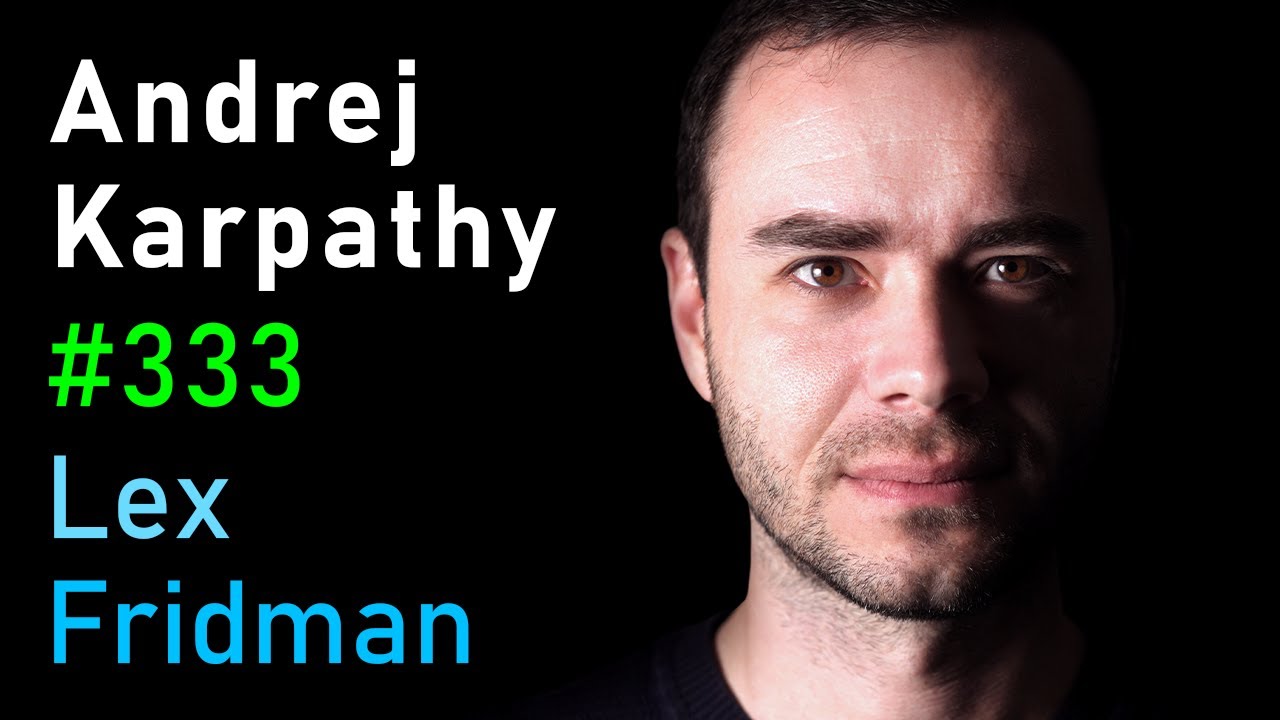
Andrej Karpathy: Tesla AI, Self-Driving, Optimus, Aliens, and AGI | Lex Fridman Podcast #333
Neural nets as alien artifacts, Software 2.0, and why the data engine beats the sensor suite. Intelligence is a compression objective, not a simulation of the brain.
Preview · 3 of 6 tactics
"Humans are just not very good at writing software, basically." — Andrej Karpathy
This is Lex Fridman in conversation with Andrej Karpathy, former director of AI at Tesla and co-founder of OpenAI, recorded in late 2022. The pop framing of this conversation is two AI people talking shop about neural nets and self-driving. The actual operating system underneath is sharper: Karpathy has a coherent philosophy about where intelligence comes from, how to build teams around it, and why almost every conventional assumption about sensors, data, and academic research points in the wrong direction. The protocol pulls from three hours of conversation spanning transformer architecture, the Tesla data engine, Software 2.0, the future of language models, and what a productive life in deep learning actually looks like.
Treat Neural Nets As Alien Artifacts, Not Brain Simulations
Karpathy is more cautious about brain analogies than almost anyone else in the field. The standard story in AI is that neural networks are inspired by the brain, so insights flow in both directions. Karpathy rejects this framing at the source. The optimization process that produced the brain, millions of years of multi-agent self-play under survival pressure, is categorically different from the process that produces a trained neural network, which is a compression objective applied to a massive dataset. The artifacts you get from each process are not comparable. His preferred description is blunt: a trained neural network is a complicated alien artifact. You do not make analogies to the brain because the analogy breaks down at the level of how the thing was built. Biological neural networks are trying to survive. Artificial ones are trying to compress the internet. Those are different problems, they produce different solutions, and pretending otherwise leads researchers to import intuitions that do not transfer. This matters practically because it keeps the work honest. If you think you are building a brain, you will reach for neuroscience when you are stuck. If you accept that you are building an alien artifact shaped by gradient descent on text, you ask better questions: what does this compression objective actually reward, what emergent structure does it force the network to learn, and how do you probe that structure without anthropomorphizing it?
THE PLAY
When you next evaluate a model's behavior, describe what you observe without using brain or human cognition analogies. Instead ask: what must the compression objective have forced this network to represent in order to minimize loss on this data? Run one analysis session this week using only that framing and note where your conclusions differ from your default interpretations.
Build The Data Engine, Not The Feature Detector
Karpathy's clearest operational insight from Tesla is about where the real work happens in a machine learning system. Most engineers think the hard problem is the neural network architecture. The actual hard problem is the data engine: the closed loop by which you deploy a model, observe where it fails, reconstruct ground truth for those failure cases, add them to the training set, and retrain. Architecture choices matter at the margin. The data engine is what determines whether you make systematic progress or not. The data engine has three requirements for the training set it produces: it must be large, it must be accurate with no labeling mistakes, and it must be diverse. Diversity is the one people underweight. A training set that is enormous but covers a narrow slice of the input distribution will produce a model that fails exactly where you need it most, on the rare cases. The data engine's job is to find those pockets and fill them. You deploy to mine for the gaps, not to ship a finished product. At Tesla this translated into a concrete loop. Deploy the model. Observe failures in the fleet. Run an offline reconstruction process on those failure cases to recover 3D ground truth automatically. Add those cases to the dataset. Retrain. The offline tracker could use neural networks too large to run on the car at test time, unlimited compute, and full video context because it was running after the fact with no latency constraint. This asymmetry between what you can use for annotation and what you can use for inference is one of the structural advantages of the data engine approach that most teams do not fully exploit.
THE PLAY
Map your current model development process against the three data engine properties: large, accurate, diverse. Identify which of the three is the binding constraint right now. Spend the next sprint entirely on that constraint, not on architecture changes or hyperparameter tuning, and measure whether your eval metrics move more than they did in the previous sprint.
Newsletter
Get each new playbook the day it drops
One email per drop. No spam. Unsubscribe anytime.
Vision Is Necessary And Sufficient, Everything Else Is Entropy
When Tesla removed radar and then ultrasonic sensors from its vehicles, the outside reaction treated this as a cost-cutting move dressed up in philosophy. Karpathy's actual reasoning is more structural and applies well beyond automotive. The question is not whether an additional sensor provides incremental information. The question is whether the full cost of that sensor, supply chain, firmware, calibration, manufacturing hold time, organizational focus, dataset complexity, is worth the delta in system performance. Camera-based vision has two properties that no other sensor matches simultaneously. It is necessary because the physical and digital world is designed for human visual consumption. Road signs, lane markings, traffic signals, everything is built to be seen. And it is sufficient because humans drive using vision and manage to do so reliably enough that the driving task is clearly solvable with that sensor alone. If a sensor is both necessary and sufficient, adding more sensors does not improve the ceiling, it adds drag. The organizational cost is the part engineers undercount. Every additional sensor creates a column in your database, a distribution shift when that sensor model changes, a team responsible for its firmware, a source of noise in your training data, and a distraction from the sensor that carries the most information. At Tesla, removing radar and going all-in on vision meant that all engineering focus, all data collection, all compute, all iteration was concentrated on the single sensor that actually mattered. Karpathy's term for this is fighting entropy. Best part is no part applies to sensors the same way it applies to manufacturing steps.
THE PLAY
List every data source or sensor your current system ingests. For each one, answer two questions: is it necessary given that some other source already covers this modality, and is the performance delta it provides worth the full organizational cost of maintaining it? Cut anything that fails both questions. Do this audit this week, not when you next do a system redesign.
Subscribers Only
Unlock the Full Playbook
3 more tactics + Action Plan
TACTIC 04
Program In Software 2.0: Change The Dataset, Not The Code
TACTIC 05
Use Sublinear Difficulty Scaling To Justify Ambitious Targets
TACTIC 06
Measure Hours, Not Choices, To Build Expertise
Already subscribed? Log in
LEX FRIDMAN · EXTRACTED BY PODEX