ACQUIRED · EXTRACTED
Jensen Huang
6 principles from NVIDIA's CEO interview — on building conviction, learning from suffering, and leading through the AI revolution.
3.2M views on YouTube"I hope that you have the gift of having suffered a little bit. Because it makes you resilient. And I think resilience is a superpower."
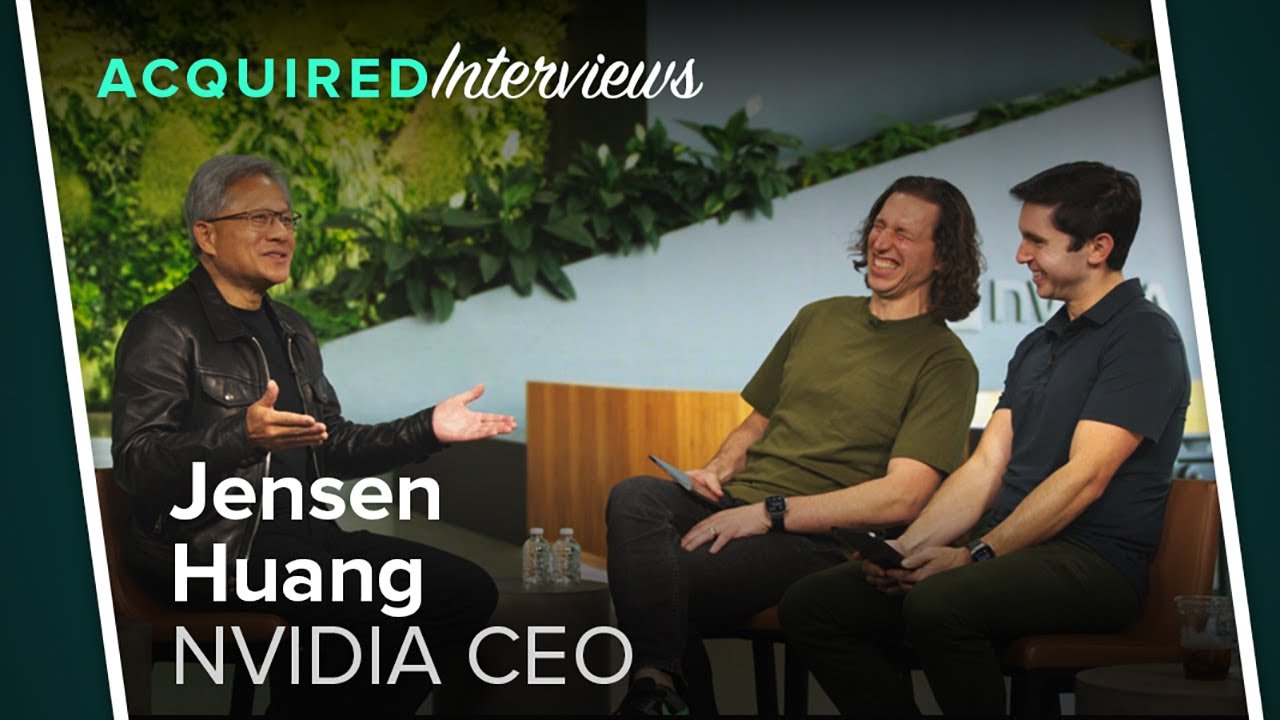
In 2023, Ben and David finally sat down with Jensen Huang himself — after seven hours of covering NVIDIA across three episodes. Jensen is one of the most unusual CEOs in history: a Denny's waiter who built the most valuable semiconductor company on earth, held onto his vision through multiple near-death experiences, and at age 60 became the most important person in tech. This conversation reveals the mental models behind the man.
Suffering Is the Source of Resilience
Jensen's commencement speech advice: 'I hope you've suffered enough.' This is not provocative — it is his genuine belief. He went to boarding school at 15 in Kentucky knowing no one. NVIDIA nearly died three times. Each near-death experience calibrated his expectations downward and his resilience upward. He believes people who have never experienced serious difficulty are fragile — one setback destabilizes their entire worldview. People who have suffered and survived have a tested framework for continuing. 'I don't celebrate success. I celebrate resilience.'
THE PLAY
In hiring and team-building: look for people who have been tested by failure, not just decorated by success. Ask about the hardest thing they've been through and how they processed it. The answer tells you more about future performance than any success story.
The CEO as Chief Reasoning Officer
Jensen rejects the title of 'Chief Executive.' He calls himself the 'Chief Reasoning Officer.' His job is to model good reasoning publicly — to think out loud, to show how he processes information, to make the epistemics of good decisions visible to the organization. He argues that the CEO's most important output is not decisions but the reasoning culture those decisions create. If you make good decisions in opaque ways, the organization learns nothing. If you make good decisions transparently, the organization learns to reason well.
THE PLAY
In your next major decision, make the reasoning public before announcing the conclusion. Share the information you're weighing, the uncertainties you see, and the framework you're applying. This builds organizational reasoning capacity that compounds over time.
The Flat Organization as Information Architecture
Jensen has 40+ direct reports at NVIDIA. This is not chaos — it is deliberate information architecture. In a hierarchical org, information flows through layers and degrades at each one. With 40 direct reports, Jensen gets unfiltered information from 40 parts of the organization simultaneously. He doesn't manage them — he processes their information and provides context and direction. The flat structure is a sensing system, not a management system. Most CEOs have 5-8 direct reports. Jensen argues this is information starvation.
THE PLAY
Audit your information architecture: how many filtered layers does important operational information pass through before it reaches you? Each layer is a compression that loses signal. Find the 3-5 areas where you most need unfiltered signal and build direct lines to those sources.
The Long Zoom
Jensen thinks in two timescales simultaneously: what needs to happen this quarter, and what the world will look like in 10 years. He calls this 'the long zoom.' The long zoom allows him to make investments that look irrational in the short term (CUDA, ARM architecture, robotics) because he can see where they land on the 10-year map. Most executives get trapped in quarterly thinking because their incentives are quarterly. Jensen's incentive structure (he owns 3% of NVIDIA) aligns him with the 10-year outcome.
THE PLAY
Force yourself to write a 10-year vision for your market once a year. Not a forecast — a vision of what the world will look like if the biggest trends continue. Then ask: what would you have to start building today to be positioned for that world? Build that thing.
Intellectual Honesty as Competitive Advantage
Jensen is unusual among tech CEOs for one thing: he changes his mind publicly and says so explicitly. When NVIDIA's gaming business declined in 2022, he called it precisely and accurately in an earnings call — no spin, no 'headwinds,' just a clear description of what happened and why. This intellectual honesty has made investors and analysts trust his assessments more than any other CEO in semiconductors. When Jensen says something is going well, the market believes him. That trust is a compounding asset.
THE PLAY
In your next public or internal business update, describe one thing that went worse than expected and why — with no softening. The credibility you build by being honest about failures makes everything you say about successes more valuable.
Build for the Imagined Future, Not the Current Market
When Jensen launched CUDA in 2006, the total addressable market was approximately zero. No one was doing GPU compute. He built it anyway because he could see — based on his understanding of physics, algorithms, and computing trends — that parallel computing would eventually be needed at scale. The AI revolution vindicated him 15 years later. His framework: if you can see a future state of the world that is clearly better than today and clearly achievable given known physics and economics, build for that future state now. The market will arrive.
THE PLAY
Identify one future state of your market that is clearly better than today and achievable with known technology. What would you build today if you were certain that future was coming in 10 years? Start building it. The market will arrive, and you'll be ready.
YOUR ACTION PLAN
All the plays, back to back. Use this as your checklist.
- 01
Suffering Is the Source of Resilience
Hire for resilience, not just achievement. Ask about failure. How someone processed it predicts how they'll handle the next one.
- 02
The CEO as Chief Reasoning Officer
Show your reasoning before showing your conclusion. The reasoning is what the organization learns from.
- 03
The Flat Organization as Information Architecture
Each management layer is information compression. Find where you need unfiltered signal and build direct lines there.
- 04
The Long Zoom
Write the 10-year vision annually. Then ask what you'd need to start building today to be positioned for it.
- 05
Intellectual Honesty as Competitive Advantage
Be the person who calls failures clearly. Credibility about failures makes everything you say about successes worth more.
- 06
Build for the Imagined Future, Not the Current Market
Find the future that's clearly better and clearly possible. Build for it now. The market will arrive.
Newsletter
Get each new protocol the day it drops
One email per drop. No spam. Unsubscribe anytime.
ACQUIRED · EXTRACTED BY PODEX